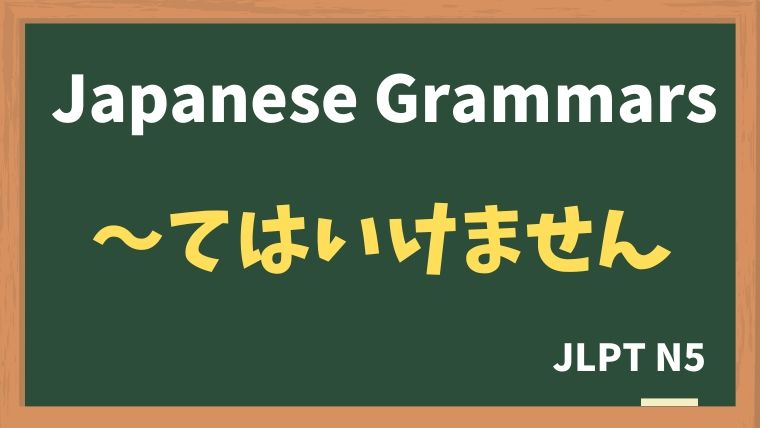
Explanation:〜てはいけません
fa-check-circleMeaning
"You must not do..."
Used to indicate prohibition, meaning "you must not" or "you cannot" do something. It is used to tell someone that a particular action is not allowed.
fa-check-circleForm
V(Te-form) + はいけません
fa-check-circlePoints
- Prohibition: "〜てはいけません" is used to prohibit an action or behavior, often in formal or polite contexts.
- Politeness: This structure is polite and can be used when speaking to someone you don't know well or in formal situations.
- Verb Conjugation: The verb is conjugated to its Te-form (〜て), followed by "はいけません" to complete the prohibition.
fa-check-circleJLPT Level
N5
fa-check-circleNote
The particle "の" is always used before this grammar pattern.The causal way is "〜じゃいけない"/ “〜ちゃいけない".
ex.
| のんではいけません | のんじゃいけない |
| たべてはいけません | たべちゃいけない |
| コピーしてはいけません | コピーしちゃいけない |
Sample sentenes
飛行機の 中で、タバコを 吸ってはいけません。
You must not smoke inside the airplane.
映画館で、撮影してはいけません。
You must not shoot in the cinema.
図書館では 大きな 声で 話てはいけません。
You must not talk loudly in the library.
未成年は お酒 を飲んではいけません。
A minor must not drink liquor.
この 美術館では 絵に 触れてはいけません。
You must not touch the paintings in this art museum.
テスト中に 辞書を 使ってはいけません。
You must not use the dictionary during the examination.
この川で 泳いではいけません。
You must not swim in this river.
Vocabulary
| Japanese | English |
| さつえいする | to shoot |
| こえ | voice |
| はなす | to talk |
| みせいねん | minor |
| びじゅつかん | art museum |
| ふれる | to touch |