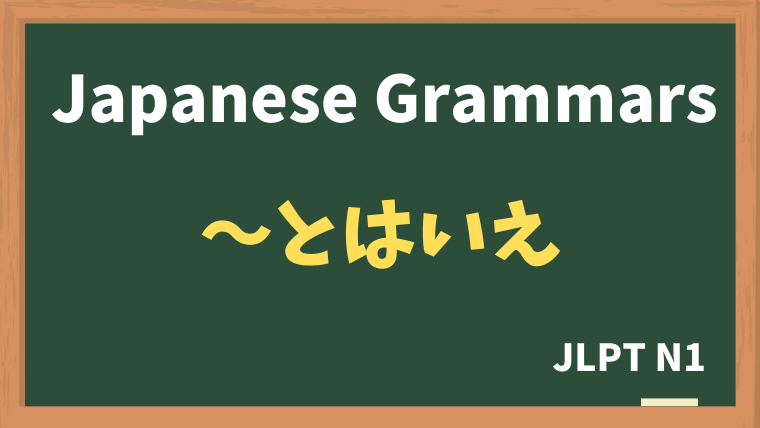
Explanation:〜とはいえ
fa-check-circleMeaning
"〜といっても / 〜けれども"
Used to acknowledge a certain fact or situation, followed by a contrasting statement or exception to that fact. It can be translated as "having said that," "even though," or "nevertheless" in English. This expression is often used to introduce a counterpoint or to highlight that, despite certain conditions being true, the speaker's point still stands.
fa-check-circleForm
V(plain form)+ とはいえ
イA(plain form) + とはいえ
ナA(plain form)+ とはいえ
N(plain form)+ とはいえ
fa-check-circlePoints
- Acknowledgment + Contradiction: "〜とはいえ" is used to first acknowledge a fact or situation, but then it is followed by a statement that contradicts or limits the impact of the initial fact.
- Casual to Formal Usage: It can be used in both formal and casual situations, depending on the context.
- Contrastive Meaning: The contrast often implies that, despite acknowledging the situation, it does not fully change the speaker’s view or the reality of the following statement.
fa-check-circleJLPT Level
N1
Sample sentenes
私は日本人だとはいえ、アメリカで育ったので、日本語が話せません。
Although I am Japanese, I grew up in America, so I can’t speak Japanese.
男女平等とはいえ、会社で地位が高い人はたいてい男性だ。
Even though there is gender equality, most high-ranking positions in companies are held by men.
あの大学に入るのは難しいとはいえ、しっかり勉強すれば誰でも合格することは可能だ。
Although it is difficult to get into that university, anyone can pass if they study hard.
たとえ食べ放題だとはいえ、食べきれない量を取って残すのはよくないよ。
Even if it’s an all-you-can-eat buffet, it’s not good to take more than you can eat and leave food behind.
手術は成功したとはいえ、しばらくは様子を見る必要があります。
Although the surgery was successful, we still need to monitor the situation for a while.
ここは駅から近いとはいえ、自転車でも10分はかかる。
Although this place is close to the station, it still takes 10 minutes by bicycle.
Vocabulary
| Japanese |
English | |
| 地位 | ちい | position / status |