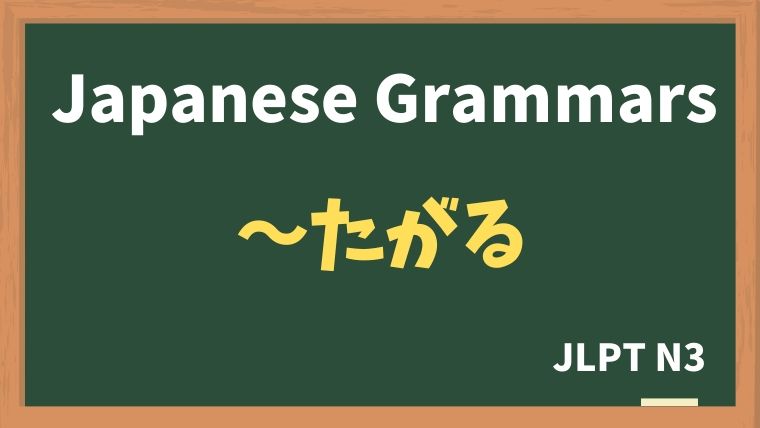
Explanation:〜たがる
fa-check-circleMeaning
"a third person wants to do..."
Used to describe a third person's desire or wish to do something. It indicates that someone (other than the speaker) wants to do a particular action or shows a tendency or inclination to do it.
fa-check-circleForm
| Structure | Example |
| V(masu form) |
食べたがる(wants to eat) |
fa-check-circlePoints
- Third-Person Desire: "〜たがる" is used specifically to express the desires, wants, or inclinations of someone else, not the speaker. When expressing one's own desires, the form "〜たい" is used instead.
- Observable Behavior: "〜たがる" is often used when the desire or inclination of the third person is observable through their actions, words, or behavior.
- Conjugation: "〜たがる" attaches to the stem of a verb, followed by the auxiliary verb "がる," which then conjugates like a regular verb (e.g., "たがっている" for ongoing desire).
fa-check-circleJLPT Level
N3
fa-check-circleForm
The negative form "〜たがる" is "〜たがらない".
Sample sentenes
ベンさんはいつも授業をサボりたがります。
Ben always wants to skip class.
ジェームスさんは漢字を覚えたがりません。
James doesn’t want to memorize Kanji.
息子は学校に行きたがりません。
My son doesn’t want to go to school.
田中さんはどんなに忙しくても残業したがりません。
No matter how busy Tanaka is, he doesn’t want to work overtime.
キムさんは悪いことをしたのに謝りたがりません。
Kim doesn’t want to apologize despite of doing something bad.
猫は外に出たがっているようだ。
The cat seems to want to go outside.
彼女はいつも新しい服を買いたがる。
She always wants to buy new clothes.
子供たちはアイスクリームを食べたがっている。
The children want to eat ice cream.
Vocabulary
| Japanese |
English | |
| - | サボる | to skip the class |
| 残業する | ざんぎょうする | to work overtime |
| 謝る | あやまる | to apologize |
| 外 | そと | outside |