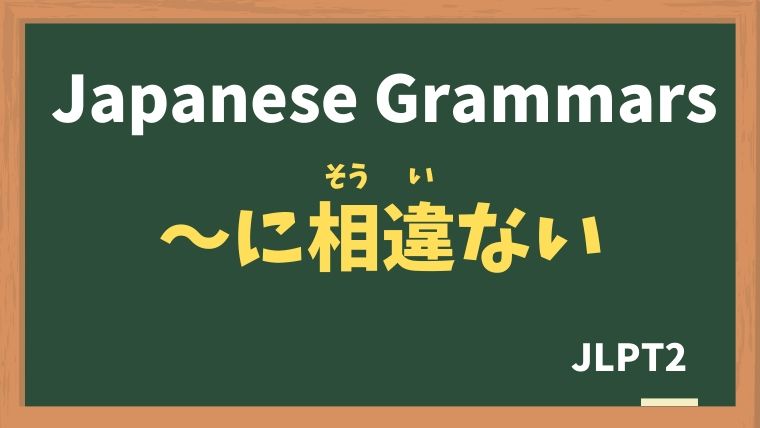
Explanation:〜に相違ない
fa-check-circleMeaning
"〜に違いない / きっと〜だ"
"it must be so / I'm sure 〜 / there's no doubt that"
Used to express strong certainty or conviction about something. This phrase is often used in formal or written contexts when the speaker wants to assert that something is undoubtedly true.
fa-check-circleForm
V(plain form)+ に相違ない
イA(plain form)+ に相違ない
ナA + に相違ない
N + に相違ない
fa-check-circlePoints
- Certainty: It conveys a high degree of confidence or assurance.
- Formal: This expression is often used in formal speech or writing.
- Subjective Assumption: It implies that the speaker's judgment is based on evidence or reasoning, rather than an objective fact.
fa-check-circleJLPT Level
N2
Sample sentenes
彼の言っていることは嘘に相違ない。
There's no doubt that what he's saying is a lie.
犯人はあの男に相違ない。
There is no doubt that the culprit is that man.
家でオンラインで勉強したほうが効率がいいに相違ない。
There is no doubt that it is more efficient to study online at home.
この会社はよく人が辞めているし、何か問題があるに相違ない。
There is no doubt that this company has a high turnover rate, so there must be something wrong.
Vocabulary
| Japanese |
English | |
| 犯人 | はんにん | suspect / perpetrator |
| 効率がいい | こうりつがいい | efficient |